Pip Pattison Oration: Jay McClelland
Share via
Abstract
We live in a world where AI seems to be improving in its capabilities everyday, exceeding human abilities in many domains. AI systems use principles and processes similar to the those at work in our brains when we perceive, think, experience the world and reason, and their strengths and weaknesses are like ours. Understanding these similiarities, Jay argues, can help us understand — and relate to — both ourselves and our machines. But we get by with far less than today's AI systems in many ways — far less data, far less parallel computation, and far less exact storage of our recent mental states. How do we do it? This remains an important unanswered question about the human mind. Jay will describe some of the directions we are pursuing to try to answer this question.
The Speaker
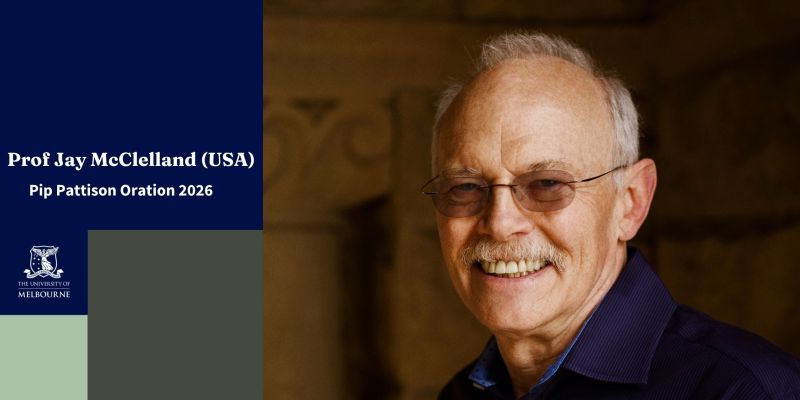
James L. (Jay) McClelland received his Ph.D. in Cognitive Psychology from the University of Pennsylvania in 1975. He served on the faculty of the University of California, San Diego, before moving to Carnegie Mellon in 1984, where he was a founding Co-Director of the Center for the Neural Basis of Cognition, a joint project of Carnegie Mellon and the University of Pittsburgh. In 2006 McClelland moved to the Department of Psychology at Stanford University, where he founded the Center for Mind, Brain, and Computation in 2007 and served as department chair from 2009 to 2012. He is currently the Lucie Stern Professor in the Social Sciences and Co-Director of the Center for Mind, Brain, Computation and Technology at Stanford and a Consulting Research Scientist at Google DeepMind.
Over his career, McClelland has combined behavioral experiments and artificial neural networks to contibute to the scientific understanding of human perception, cognitive development, language processing and learning, mathematical cognition, and the neurobiology of memory. He collaborated with David Rumelhart in the late 1970's and early 1980's, co-leading the two-volume work, Parallel Distributed Processing, which laid out a neural-network-based framework for modeling cognition and applied it to topics in computational theory, cognitive psychology and cognitive neuroscience. Among other joint awards for this work, McClelland, Rumelhart and Geoff Hinton, who also contributed to the PDP effort, received the American Association for the Advancement of Science's Golden Goose Award, which honors research conducted to address basic science questions that turned out to have practical applications. Additonal honors and awards include Membership in the US National Academy of Sciences and the British Academy, the David E. Rumelhart prize for contributions to the theoretical foundations of Cognitive Science, the NAS Atkinson Prize in Psychological and Cognitive Sciences, and the Heineken Prize in Cognitive Science.
Pip Pattison Oration
The Pip Pattison Oration is named after Professor Pip Pattison AO, a quantitative psychologist who pioneered the use of mathematical and statistical models for social networks and network processes. Pip became a lecturer in the University of Melbourne's Department of Psychology in 1977 while she was completing her PhD, and later held many leadership roles including President of the Academic Board, Pro Vice-Chancellor (Learning and Teaching) and Deputy Vice-Chancellor (Academic). Most importantly Pip has had an enormously positive influence upon her colleagues and students throughout her career and is without question one of the most respected and most loved psychologists, mathematical or otherwise. Pip is known for making her niche area of mathematical psychology relevant to many outside the field who previously didn’t even know it existed. Speakers invited to deliver an oration are chosen with this broad appeal in mind.
Register to attend in person at the Singpore Theatre, Glyn Davis Building. The oration will be 60 minutes followed by Q & A and networking.
A recording of the talk will be made available after the event on the Complex Human Data Hub YouTube.
If you have any questions about this event please email chdh-psych@unimelb.edu.au