2026 No-Bell Prize Competition
We've extended the deadline! You have an extra week to get your No-Bell Prize submissions in – submissions now close on Sunday 2 August.
Let's communicate!
Can you explain your research in 90 seconds – without any jargon?
Develop science communication skills in a supportive environment and compete for cash prizes at the 2026 No-Bell Prize competition. PhD and Masters by Research students from across MDHS are invited to take part and pitch their research in a clear and accessible way.
Submit a video, attend our free communications workshop, and compete for $2,500 in prizes at the final on 1 October.
Want a sneak peek of what to expect? Watch the video highlights from previous No-Bell Prize events for a taste of what to expect from this entertaining and educational communication initiative.
How does it work?
Brush up on your skills at our (optional) science communications workshop on 7 July, then submit a 90-second video explaining your research using clear, accessible language. The top submissions, as judged by a panel of academics from across the Faculty, will be chosen. Finalists will be offered one-on-one coaching to refine their presentation skills, before competing in a live final event on 1 October.
In the final, participants will:
- Present for 90 seconds
- Respond to three minutes of questions from the host and audience.
This comprises a total of four minutes and 30 seconds per finalist.
During the presentation, a panel will note each time they hear jargon, such as language which is too technical or acronyms that are not widely understood. An official will keep time and count the number of notes per speaker. The participant with the fewest notes during their presentation and the highest score from the panel will be the 2026 No-Bell Prize winner.
There are some great prizes on offer, including:
- $1,000 for the No-Bell Prize winner
- $500 each for the two runners-up
- A People's Choice Award of $500.
Read through the guidelines and pitch us your research to be in the running. We can’t wait to talk research with you!
MSPS acknowledge the Faculty of Medicine, Dentistry and Health Sciences (MDHS) for supporting these events via a 2026 Graduate Research Development Grant. We acknowledge the Monash University's Central Clinical School 'No-Bell Prize' website and Melbourne Neuroscience Institute (University of Melbourne) 2013 Festival of Ideas event as the basis of this event.
2026 No-Bell Prize key dates
- Tuesday 7 July 2026
-
12:30–1:30pm
Science communications workshop | Registrations closed
- Wednesday 8 July 2026
-
9:00am
Applications open
- Sunday 2 August 2026
-
11:55pm
Applications close
- Mid-August
-
Finalists announced
- Thursday and Friday 27 & 28 August 2026
-
One-on-One coaching
Finalists will be invited to one-on-one coaching. Two dates are available. - Thursday 1 October 2026
-
2:00–4:30pm
No-Bell Prize Final
Ian Potter Auditorium, Kenneth Myer Building
Register here
We've extended the deadline! You have an extra week to get your No-Bell Prize submissions in – submissions now close on Sunday 2 August.
How to apply
Applicants must submit a short 90-second video explaining their research. A panel of academics from across the Faculty will select the finalists from these submissions.
Prior to submitting a video, we encourage all applicants to attend the science communications workshop, which will be held in-person on 7 July.
Please refer to the No-Bell Prize guidelines below for more information on the application process and judging criteria. For any additional queries, take a look at our FAQ or contact the organising committee.
No-Bell Prize guidelines
Download as PDF (PDF 100.4 KB)
Competition format
Eligible applicants will submit a 90-second video, with the top presenters progressing to the No-Bell Prize Final. In the final, participants will:
- Present for 90 seconds
- Respond to three minutes of questions from the audience and host.
This comprises a total of four minutes and 30 seconds per finalist.
During the presentation, a panel will note each time they hear jargon, such as language which is too technical or acronyms that are not widely understood. An official will keep time and count the number of notes per speaker. The participant with the fewest notes during their presentation and the highest score from the panel will be the winner.
Participants who progress to the final will be competing for cash prizes, including:
- $1,000 for the No-Bell Prize winner
- $500 each for the two runners-up
- A People's Choice Award of $500.
Eligibility
The competition is open to students who are currently enrolled in an eligible graduate research degree (PhD, Master of Philosophy, Masters of Research, Doctor of Medical Science) within the University of Melbourne’s Faculty of Medicine, Dentistry and Health Sciences.
Application process
To compete, applicants must register and submit a video as detailed below. Submissions will be assessed in line with judging criteria. These videos will be used by the selection panel to select the finalists and will not be made available outside of this process.
- Attend communications workshop (optional): All students are encouraged to attend a communications skills workshop to develop their research-related communication and presentation skills. This will be held on 7 July, prior to submissions opening.
- Register and submit a video by the deadline (extended to 2 August) via the No-Bell Prize application form.
- Video assessment: Submissions will be assessed by a selection panel, based on the judging criteria below. The highest-ranked videos will be selected to compete in the final. Applicants will be notified mid-August.
- Final event: The selected finalists will receive tailored coaching on 27 or 28 August, and compete in the final on 1 October, 2:00-4:30pm.
Recording guidelines
Guidelines for submitted videos:
- The 90 second video should focus on one study, one result or an overview of a whole research project.
- The decision of the selection panel is final.
- Content delivered after the 90 second mark will not be considered by the selection panel.
- Presentations are considered to have commenced when a presenter starts their presentation through speech. The audio must be continuous, with no sound edits or breaks.
- Applicants must ensure they are clearly visible and the audio is clear. Audio-only entries are not permitted.
- No slides or props (like costumes or lab equipment) are to be used. No additional electronic media (eg, sound or video files) are permitted within the video recording.
- Submissions must be made via a video format. Files submitted in other formats will not be accepted.
- Submissions should be no larger than 1 GB. Larger files will not be accepted by the form.
- Applicants will not be judged on video/recording quality or editing capabilities; rather, submissions will be assessed on content based on the judging criteria below.
Judging criteria
Comprehension and content:
- The presentation provided clear research context, significance and potential impact.
- The presentation followed a clear and logical sequence.
Engagement and communication:
- The presentation was delivered clearly and the language used was appropriate for a non-specialist audience.
- The speaker had sufficient ‘stage presence’, eye contact and vocal range; the speaker maintained a steady pace and had a confident stance.
- The speaker avoided scientific jargon, explained terminology and provided adequate background information to illustrate points.
- The presenter conveyed enthusiasm for their research, and captured and maintained the audience’s attention.
Presenting in the final competition
If selected to present in the No Bell Prize final, you will be asked to present your research in person for four minutes 30 seconds, which includes 90 seconds to introduce your research and three minutes of questions from the audience and host. You must not use slides or other props.
If you progress to the final, you will also be offered two additional seats at the No-Bell Prize event for anyone you would like to invite to support you on the day.
Resources
You can find some tips on recording your presentation here (noting that your video submissions will not include a slide).
Please join us for the 2026 No-Bell Prize Final, featuring some of the best and brightest graduate researchers from across the Faculty competing to be the most engaging and accessible science communicator.
With the opportunity for audience questions, this interactive event is a must-see for anyone interested in science communication or discovering the breadth of research being undertaken across the Faculty.
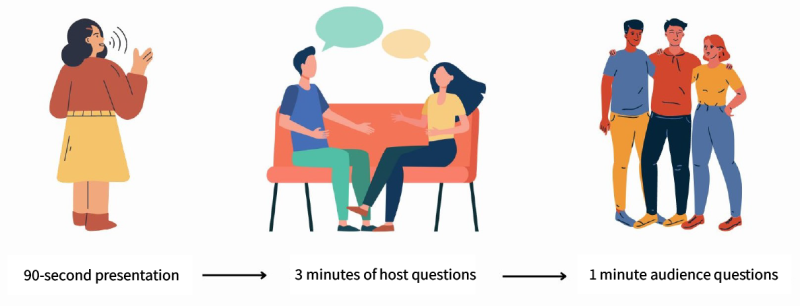
Having been selected by our panel based on a video submission, each graduate researcher is tasked with communicating their research in a fun and interactive way, free from jargon. Each finalist will have 90 seconds to introduce and explain their research, followed by three minutes of questions from the audience and host.
They’ll be competing for not only the title of No-Bell Prize Winner for 2026, but a number of cash prizes, including $1,000 for the No-Bell Prize winner and $500 each for the two runners-up. The audience will also vote for the People's Choice Award.
Light refreshments will be provided.
Event details
Date: Thursday 1 October 2026
Time: 2:00–4:30 PM
Venue: Ian Potter Auditorium, Kenneth Myer Building, University of Melbourne, Parkville
2025 No-Bell Prize winners
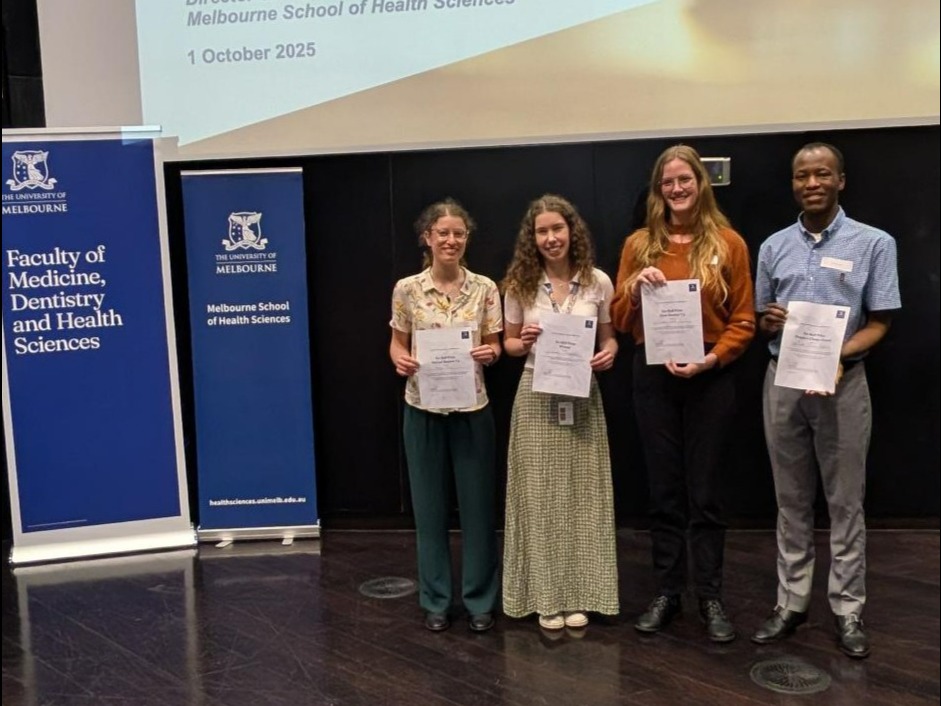
Congratulations to our 2025 No-Bell Prize winners! Last year's event, hosted by the Melbourne School of Health Sciences, saw the following students take out the final honours:
- First Prize: Dominika Michalek – Sir Peter MacCallum Department of Oncology
- First runner up: Jessica Hall – Biochemistry and Pharmacology
- Second runner up: Ashlyn Kerr – Microbiology and Immunology
- People's Choice: Zilefac (Brian) Ngokwe – Melbourne Dental School
Frequently Asked Questions
Find all the answers to your No-Bell Prize questions on this page. If you have any other questions, or you'd like to speak to the 2026 organisers, please contact the MSPS Engagement Team at engagement-psych@unimelb.edu.au.
Applications & workshops
-
Any graduate researchers currently enrolled in the University of Melbourne Faculty of Medicine, Dentistry & Health Sciences.
-
Applications for 2026 will open Wednesday 8 July and close Sunday 2 August (deadline has been extended). Applications must be submitted via the form.
-
We recommend that you participate in the workshop and coaching provided, however it is not mandatory.
-
You can record your video application using your phone or through a desktop application like Zoom. It's a good idea to record in a quiet, well-lit space so the judges can see and hear you clearly. Audio-only entries are not permitted.
You can find some tips on recording your presentation here (noting that your video submissions will not include a slide).
Your presentation should be 90 seconds long, timed from when you begin speaking. Content delivered after the 90-seond mark won't be considered by the judging panel. The recording should be continuous, with no edits or breaks.
Submissions should be no larger than 1GB and in a video format (eg, .mp4, .avi, .mov)
-
Please contact the organising team at engagement-psych@unimelb.edu.au for assistance. Please do not email your video to this address.
No-Bell Prize event
-
Jargon is language which would not be understood by people from outside your research field. This might include acronyms, technical terms and medical terms which are not explained in an accessible way.
For example, concepts like 'heuristics' or 'the Big Five', or acronyms like MHPP (Mental Health PhD Pogram) or GAD (generalised anxiety disorder) may not be immediately understood by someone outside of psychology.
-
Absolutely - there will be plenty of room, so please come along and cheer for your friends and classmates.
-
Our panel will evaluate the overall presentations, including the question-and-answer component, and will note each instance of jargon used.
A timekeeper will track the first component of the presentation, where the finalists have one and a half minutes to introduce their research. Finalists will be penalised if they exceed the 90-second mark for this introduction.
The No-Bell Prize will be awarded to the speaker who explains their research and responds to questions from the audience and host in an engaging manner with the fewest mentions of jargon.
The audience will vote for the People's Choice Award.