
Our Health Study
A person’s lifetime experiences of health and illness are determined by many factors, including their unique combination of genetic, physical, environmental, lifestyle, psychological and other traits. It is therefore important that healthcare and medical treatments are not a ‘one size fits all’ offering, and are tailored to reflect these individual differences. This personalised approach to care is known as ‘precision health’.
In this study, we seek to collect detailed information about participants' health, daily habits, experiences, lifestyle, body function and genes (DNA), through the collection of:
- Physical health measures (eg, blood pressure, bone density and lung testing)
- Questionnaires (eg, mental health, life experiences)
- Information collected from smart phones and smart watches (eg, physical activity)
- Bodily (biological) samples – (eg, blood, saliva, urine, dental plaque, and faeces). These samples also tell us about the activity of bacteria ("bugs") within the body!
All of these factors play important roles in determining health and disease throughout life. Some of the samples will undergo routine tests, like blood tests you might have at your doctors. We will also look at the microscopic things that make up our body’s cells and keep them functioning (eg, proteins, genes, and other small molecules).
By collecting such rich and detailed information from a diverse community group, we aim to improve the prevention, diagnosis, and treatment of a wide range of health conditions. We also aim to provide as much information as possible back to participants, to inform and aid your knowledge of your own health.

Find out more
To learn more about taking part in the Our Health Study, please see the following resources:
Participant Information and Consent Form (PICF)
Participant Information Booklet (PIB)

This project is a strategic priority of the University of Melbourne, and particularly the Faculty of Medicine, Dentistry and Health Sciences. The project is funded through the University, and via the Australian Government Medical Research Future Fund.

Can I take part?
To be eligible for the Our Health Study, you must be:
- Able to understand what is involved and give consent to take part
- Aged 25 to 70 years old (inclusive)
- An Australian citizen or permanent resident
- Able to understand written and spoken English
- Able to attend a half-day study visit in Carlton, and for your visit:
- Be able to fast (i.e. not consume food, caffeine, or any drinks other than water) from midnight the night prior.
- Have no acute illness (for example you must not have an infection at the time of participation) *
- Not have undergone major surgery in the past 3 months*
*If you are unsure whether you are eligibledue to recent major surgery, acute illness or any other reason, please reach out to us via email at ourhealth-study@unimelb.edu.au.
What happens if I take part?
If this study is appropriate for you, and you decide to take part, your study participation will happen over 3 phases:
Phase 1 – Pre-visit questions:
You will be asked to complete some questionnaires and information at home (on a computer or tablet) (1 hour, approximately) before your in-person study appointment.
Phase 2 – In-person appointment:
You will be invited to attend the Participant Assessment Centre (‘PAC’) in Carlton. During the visit, we will further explain what is involved and you will be asked to provide biological samples, and complete physical assessments, further questionnaires and a health interview. This visit will take around 4.5 hours in total.
Study visits are available Monday-Friday mornings only.
The PAC is located within the Australian College of Optometry, at 374 Cardigan Street, Carlton, VIC.
Phase 3 – At home measures:
A two-week monitoring phase following your visit, which includes wearing a smart watch, using a smart phone app, and completing some assessments at home. (Approximately 3 hours over 2 weeks.)
Study completion:
After study completion, you’ll receive an e-gift voucher and, with your consent, an individual report on some of your results. You can view a sample of this report here.
If you’d like to sign up for the Our Health Study, please click join the study below. Please ensure you have read the Participant Information and Consent Form (PICF) before joining the study.
If you have any questions, we invite you to view our Frequently Asked Questions or get in touch with our team: ourhealth-study@unimelb.edu.au.

The Our Health Study is being conducted by the University of Melbourne and affiliated researchers. The study has been approved by the University of Melbourne Human Research Ethics Committee (HREC #28434).
Meet the team
The Our Health Study team is made up of staff and researchers from across the University of Melbourne and the Melbourne Biomedical Precinct.
Meet the team at the Carlton Participant Assessment Centre (PAC):
- Kym Rickards – Research Coordinator / Registered Nurse
- Astha Kattel – Research Assistant / Registered Nurse
- Zoe Taylor – Research Assistant / Registered Nurse
- Dr Hasitha Pelenda – Research Assistant / Registered Dentist
- Dr Isabel Evans – Research Assistant / Registered Dentist
- Abigail Richards – Research Assistant
- A/Prof Julian Simmons – Project Supervisor
- Justine Underwood – Project Manager
- Alan Tsui – Data Manager

Lead researchers
University of Melbourne Faculty of Medicine, Dentistry and Health Science
- Prof Bernie Pope
- A/Prof Mihiri Silva
- Prof Lauren Ayton
- Ms Jessica Holliday
- Professor Yoshihisa Kashima
- Professor Nicholas Haslam
- Professor Nicholas Allen
- A/Prof Adrian Bickerstaffe
- Ms Samantha Fox
- Ms Hannah Murchie
- A/Prof Michael Menden
- Dr Amy Loughman
University of Melbourne Faculty of Science
- A/Prof Kate Howell
- Dr Robyn Larsen
- Dr Chiara Murgia
- Prof Kim-Anh Le Cao
Bio21Molecular Science and Biotechnology Institute
- A/Prof David Stroud
- Dr Subash Adhikari
- Dr Christopher Brown
- Dr Nikeisha Caruana
- Dr Daniella Hock
Murdoch Children’s Research Institute
- Professor Richard Saffery
- Dr Kim Powell

Contact the 'Our Health' Study team:
The 'Our Health' Study team can be emailed directly at ourhealth-study@unimelb.edu.au.
Visiting the PAC
The Carlton Participant Assessment Centre (PAC) is located within the Australian College of Optometry:
374 Cardigan Street,
Carlton, VIC 3053
For more information about getting to the PAC and parking, see our Frequently Asked Questions.
Frequently Asked Questions
If you have any further questions not covered below, we invite you to get in touch with our team: ourhealth-study@unimelb.edu.au.
Eligibility and participation
-
To be eligible for the Our Health Study, you must be:
- Able to understand what is involved and give consent to take part
- Aged 25 to 70 years old (inclusive)
- An Australian citizen or permanent resident (and no firm plans to move overseas, as we want to invite you back)
- Able to understand written and spoken English
- Able to attend a half-day study visit in Carlton, and for a visit with us:
- Able to fast (ie, not consume food, caffeine, or any drinks other than water) for 4 hours before your visit
- Have no acute illness (for example, you must not have an infection at the time of participation)*
- Not have undergone major surgery in the past 3 months*
*If you are unsure whether you are eligible due to recent major surgery, acute illness or any other reason, please reach out to us via email ourhealth-study@unimelb.edu.au
-
The study’s eligibility criteria were established to allow investigation of the major drivers of disease burden in Australia, and to ensure the research is safe, scientifically valid, and relevant to the population being studied. As age can influence how some things are measured, and research outcomes, participation is currently limited to individuals within the specified age range (25 to 70 years). Unfortunately, if you are outside this range, you will not be eligible to take part in the study at this time.
-
This study is investigating relationships between individual, community and environmental factors in health. These relationships change over time, and so the key reasons we are limiting participation to citizens/residents is to allow for:
- Long-term follow up
- Control for the effect of environment, as a range of factors may be different for people who live in other countries.
In future, we may expand recruitment across other groups.
-
Participation in another research study does not automatically exclude you from taking part in this study. In fact, we are partnering with some other studies to improve the research outcomes possible. However, it may depend on the nature of any other studies and whether participation in both studies could affect your safety or study results, such as if you were participating in a clinical trial and being administered medication. If you are unsure, please contact us and/or any other study you may be participating in to discuss with research staff.
-
There are no additional costs associated with participating in this study. You will receive a $50 gift voucher contributing towards your parking/transport fees and other incidental costs. This voucher will be emailed to you following the return of all study materials and equipment, about two weeks after the at-home monitoring period.
While many people do get enjoyment from contributing to important health research, you might not directly benefit from taking part in this study. However, by participating, you will help researchers understand more about health and disease, which may improve health care in the future. You will also help us to understand more about how health research is conducted – which will help us to improve participant experience.
With your consent (and where assessments are completed), we will be able to provide you with a personal report based on some of your results (eg, in relation to your bone density, body composition, physical function, diet, oral health, and eye and ear screening results) soon after the completion of your study participation. You can view an example of a full personal report here (based on mock data).
-
With your consent, and where assessments are completed, we will be able to provide you with an individual report on some of your results two weeks after the completion of your study participation. These may include results in relation to your bone density, body composition, physical function, diet, oral health, and ear and eye screening. You can choose what results you’d like from a list we will provide.
Reports will include some current scientific information and general recommendations. For some of this information, indicators will be provided on how your results fit the recommended or typical range for your age, and if follow up with a healthcare provider is recommended. We will not share these reports with anyone else, including your doctor, but you may choose to do so yourself. For more details on each measure and what results we can provide back to you, please see the Participant Information Book.
These reports will be provided to you free of charge.
View an example of a full personal report (based on mock data).
Please note that if we identify a potentially serious risk to your health, wellbeing or safety (or that of another person), we may need to return this information to you or another appropriate person. This would occur even if you chose not to receive a personal report, as we have a duty of care where serious risk identified. See some examples of serious potential health and safety risks. You may choose not to participate in this study for that reason. Please read the Participant Information and Consent Form for more information.
-
The types of genetic and microbiome analyses conducted in this project are not intended to provide individual information about your current or future health, the health of your family members, or the risk of having children with a genetic disorder. Furthermore, because your samples will be stored and analysed at a later date yet to be determined, we cannot offer to provide you with any individual results from the genetic or microbiome analyses of your samples at this stage. If you have any health concerns, we strongly recommend you speak with a healthcare provider (or emergency service, if urgent).
-
If you choose to receive a Personal Report, you will receive this around 2 weeks after you have completed your study participation (including the at home monitoring period). In some cases, results may be returned to you sooner, such as if a risk to your health is indicated. You can read more about return of informationin the Participant Information and Consent Form.
Data and privacy
-
We are collecting a wide range of detailed information in this study, and that may raise privacy concerns for you.
We take strict precautions to safeguard your confidentiality, privacy, samples and data. However, it is possible that someone could gain unauthorised access or break into the system that holds your personal data. In this circumstance, someone may be able to learn something about you if your information is able to be linked to your personal details. There might also be additional privacy risks that we have not considered.
We will take all reasonable steps to protect you from this and related risks, such as using unique identification codes and passwords, de-identifying all samples and data, and by restricting and monitoring access to research databases and all related systems. You can read more about this in the Participant Information and Consent Form.
Please note that some information you provide may be linked back to you should one of the three following specific cases arises:
- You request a personal report about your results
- We identify that there is a potentially significant health/wellbeing concern, which includes if there is a serious risk of harm to you or another person
- If we have a legal obligation of disclosure (eg, if information is subject to Victoria’s Child Protection Mandatory Reporting Framework, or we are ordered by a court to release information).
More information about B and C are provided below and in the Participant Information and Consent Form.
-
All information collected in this research study will be treated as confidential. Information can only be disclosed with your permission, except as required by law. For example, confidentiality may need to be broken if you share information indicating a threat to your own or others’ safety.
Recognising the sensitive information that is collected, stored and processed, the risk of a data security breach is minimised using rigorous protocols. This includes separating and restricting access to all information that could identify participants from study data used for research purposes.
To protect your privacy, we will:
- Follow the Australian Privacy Act 1988 (Cth) and all relevant privacy requirements
- Enforce strict and enduring safeguards, governance frameworks and data access controls, consistent with the Australian Government endorsed ‘Five Safes’ framework
- Store research data securely only on research data platforms approved by the University of Melbourne
- Restrict access to raw and identifying data to authorised members of the study team, and only where access is essential to meet the other obligations described here
- Take steps to prevent anyone from accessing information that identifies you unless they need to and are authorised to do so, for example, to check it in an audit
- Give all data codes and keep them separated from anything that could easily identify you, like your name or contact information
- Require our partner services to be assessed per the University’s Privacy and Information Security policies
- Require our partner services to delete all information on a regular basis as part of contract of service.
You can read more about this in the Participant Information and Consent Form.
-
We will collect information for this study directly from you, via online questionnaires, and in person via interview, biological sample collection, and direct physical measures and tasks. We will also collect information through our partner services – Melbourne Health Pathology, Australian Eating Survey, Ksana Health and FitaBase. You can view our Third Party Partners - Privacy and Data Security Policies.
All information collected will be linked to a unique code – also known as an identification number – that is created for you. This de-identification means data will not be linked to your name or contact information (ie, stored anonymously).
Please note that some information you provide may be linked back to you should one of the three following specific cases arises:
- You request a personal report about your results
- We identify that there is a potentially significant health/wellbeing concern, which includes if there is a serious risk of harm to you or another person
- If we have a legal obligation of disclosure (eg, if information is subject to Victoria’s Child Protection Mandatory Reporting Framework, or we are ordered by a court to release information).
The only other exception to this is the FitBit smartwatch data collection, as FitBit requires you to have your own online account. You will always be in control of the account. We will ask to have access to some data in that account during the two weeks you are wearing the watch. We recommend that you review the privacy policies of our third-party partners here to understand how they manage personal information. As noted, all partners and processes have undergone a comprehensive privacy, cybersecurity and information management review process, and been given a low-risk rating by the University of Melbourne.
-
Your participation may include using a smart phone app (Ksana Health EARS) for passive data collection of phone use.
With your permission, the Ksana EARS smartphone app will collect data relating to your phone use, geographical location, music and activity.
EARS will collect information about your phone’s general location (GPS data). This will help us study how the places and environments people spend time in are related to health, such as access to services, transport and green space, and exposure to pollution. The EARS app includes a dedicated keyboard. The keyboard will collect keystroke data from your phone and provide information about general language use. This allows us to examine how patterns of language use, rather than content of conversations, are related to health. To help protect your privacy, only summarised results will leave your phone, and these data will be analysed through automated computer methods. Similar types of information are collected by many smartphone applications you will already have on your phone. However, in this study, the information is collected only for research purposes, for a limited time, and is subject to strict security controls.
EARS does not collect data in password protected fields, such as banking or MyGov apps. You can also read the Ksana Privacy policy here.
-
Future genetic research may be conducted as part of this study. This means using the DNA from participant samples to investigate specific genes and gene combinations to examine relationships with the other data collected. As genetics is a fast-growing field, your DNA could also contribute to new research areas that we have not considered yet.
The type of genetic analyses conducted in this project are not intended to provide information about your future health, the health of your family members, or the risk of having children with a genetic disorder. Please note, we cannot provide you with any individual results from the genetic analyses of your samples at this stage. As a result, we do not reasonably expect that it will have any consequences for your future insurance or employment.
You have the choice to decide if future genetic research is conducted using your samples. If you do give us permission but later decide to withdraw that permission, you can contact the study team at any point and request that any unprocessed samples be destroyed and not included in future research. A risk of genetic research is a potential loss of privacy. We take strict precautions to safeguard your confidentiality, privacy, samples and data. However, it is possible that someone could gain unauthorised access or break into the system that holds your personal data. In this circumstance, someone may be able to learn something about your health if your genetic information is able to be linked to your personal details. There might also be additional privacy risks that we have not considered.
You can read more about this in the Participant Information and Consent Form.
How to get involved
-
If you’d like to be part of the Our Health Study, you can submit your registration and consent here. Please ensure you’ve read the Participant Information and Consent Form first. If you are eligible, you’ll receive an email with instructions for booking an appointment via our booking platform.
If you have questions and would like these answered prior to booking an appointment or attending the onsite assessment, please contact the research team via email: ourhealth-study@unimelb.edu.au.
-
Our study visits go for approximately 4 to 4.5 hours. We offer appointment times Monday to Friday, starting at 8.30am.
-
Importantly, we will ask you not to eat or drink anything (other than plain, unflavoured water), and not to smoke, vape, chew gum, consume caffeine or brush your teeth from midnight on the day of your visit. Also, please drink at least ½ a litre (ie, 500ml) of water in the hours leading up your visit, as this makes sample collection easier and more comfortable for you.
On the day of your visit, please bring your smart phone, wear comfortable, non-restrictive clothing, and avoid wearing excessive jewellery. Please wear your glasses (rather than contact lenses) on the day.
Everything else, including snacks and water, will be provided on the day but you are more than welcome to bring your own snacks and drink bottle.
If you take regular medications in the morning, please take these as usual on the day of your visit. If your medications require you to have them with food, if they can be delayed we ask you to please bring your medications with you and you can have them when you have snack break. If they can’t be delayed, please get in touch with our team to discuss: ourhealth-study@unimelb.edu.au.
Please refer to the Participant Information Book for more information about preparing for your visit. You’ll also receive an email one week prior to your booked visit with detailed instructions.
Getting to your appointment
-
Our Participant Assessment Centre (the ‘PAC’) is located at ACO Eye Health at 374 Cardigan Street, Carlton, VIC 3053. Directions are available by clicking here.
When you arrive in the foyer of the ACO Eye Health building, please contact the research team via phone (our number will be provided in booking confirmation email) and one of the team will come to collect you. There will also be a notice in the foyer with these details, so you don’t need to remember them.
-
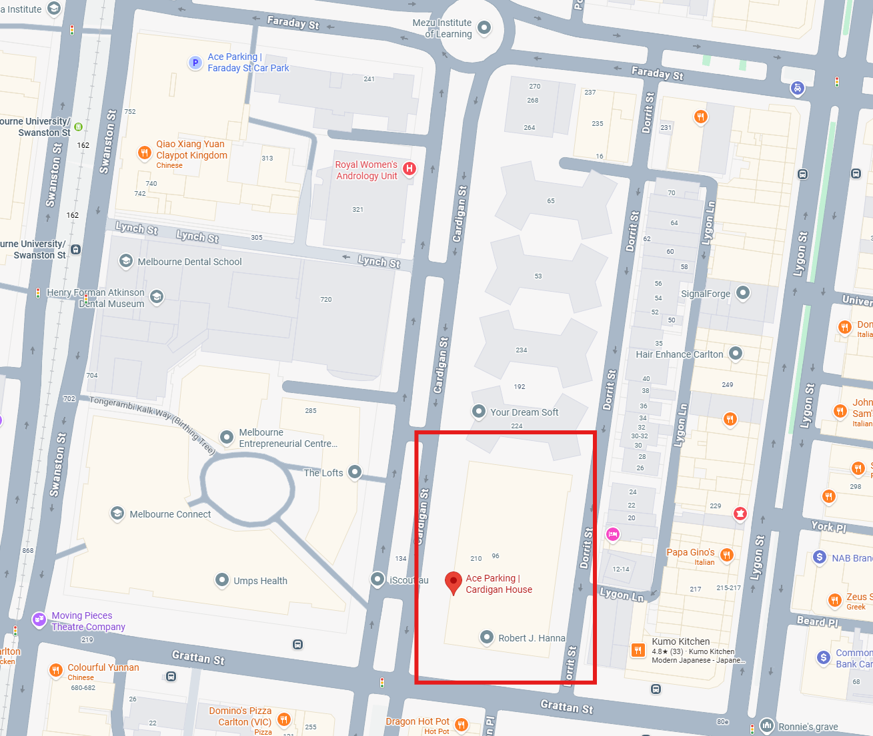
Option 1: Cardigan House, Grattan Street | Ace Parking located at 96 Grattan St Carlton. This car park is about a 7 minute walk from the PAC. See their website for information about rates. Parking availability is not guaranteed and becomes limited as the day progresses.
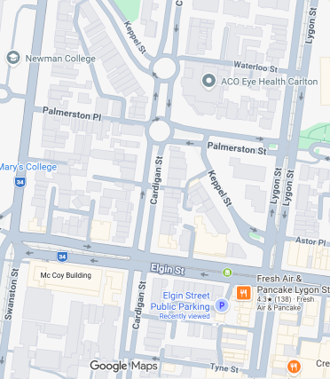
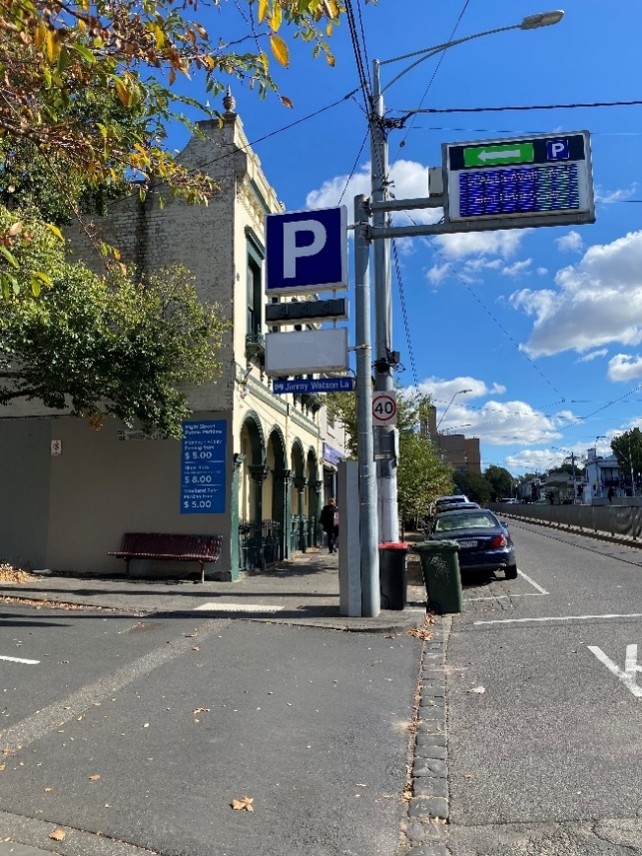
Option 2: Elgin Steet carpark, located at 215 Eglin Street, Carlton (pictured below). This carpark is about a 5 minute walk from the PAC. For information about rates, visit the City of Melbourne's website and scroll down to the ‘Elgin Street car park’ entry.
Note: There is limited free 2-hour street parking around PAC. Please note that parking in these areas will disrupt the flow of your visit and will lead to a longer study visit time at the PAC. We strongly encourage participants to use public transport or park at the University’s Eastern Precinct carpark.
-
If you’re feeling unwell and have cold or flu-like symptoms in the lead-up to your study visit, please contact the research team as soon as possible to discuss rescheduling your visit: ourhealth-study@unimelb.edu.au
-
We recommend allowing at least an extra 20 minutes of travel time for parking and public transport delays. Please note that if you are running late by more than 20 minutes, we may need to reschedule your appointment to ensure staffing and equipment availability. Please contact the research team as soon as possible to let them know, either via email ourhealth-study@unimelb.edu.au or the phone number provided in correspondence.
Frequently asked questions for current participants
-
-
A Google Health account is required for the use of the provided FitBit smartwatches. Setting up your account before your visit will save time on the day. It will also give you extra time if you need to find passwords.
One week prior to your appointment, you will be emailed instructions to download the Google Health (Fitbit) App from the Google/Apple app store. The email will contain links to corresponding apps and instructions.
-
Once you have downloaded the Google Health (Fitbit) app, open the app and tap ‘Sign in’. You should sign in with your nominated Google account. If you don’t have a Google Account yet, tap ‘Sign in’ and ‘Create account’ and continue following the prompts to set-up an account.
If you are unable to create a Google account and/or login prior to your appointment, there is no need to worry – just let a researcher know on your arrival and we will help you create one.
On the day of your visit, the research team will help you pair and sync your Google Health account to your provided Fitbit device during your study visit.
-
If you have had a Fitbit or previously used a Fitbit account, the Google Health app will ask you to merge these accounts if you sign in using the same email address as your previous account (your Google account). Follow the prompts in the Google Health app to assist you with merging these accounts. This will take a few minutes. If you previously had a Fitbit account with a non-Google account, you will need to create a new login with a Google account.
-
If you currently wear a Fitbit Charge 6, you can use this device for the ‘at-home’ monitoring period. We will help you connect your device to ‘Fitabase’ (a research partner) so we can access your data for the two-week monitoring period. At the end of this period, the device will disconnect from our database.
If you wear a different Fitbit device however, you will not be able to use this, and we will ask you to wear the Charge 6 provided to you instead.
-
Unfortunately not, the Our Health study has been set up and designed to collect data from the FitBit Charge 6. However, you may choose to wear both to keep collecting data for your other tracking device.
-
It is important to retain your account for the full duration of the ‘at-home’ study phase. However, after you have completed your post-visit 15-day home collection period, you may delete your Google Health (Fitbit) account. This means that Fitbit will cease any further data collection. You will receive an email with instructions on what to do on your last day.
-
The Ksana Health EARS app is a behavioural research tool. It collects your smartphone data passively, such as screen time, keyboard usage patterns and app habits to help understand behavioural patterns. The app runs in the background, collecting data about how you interact with your device. The app does not track private personal messages or information such as pin codes, passwords and credit card details. You will also be asked to complete a brief survey (about two minutes) each evening in the EARS app, about mood, diet, exercise and sleep.
If you would like to learn more about Ksana Health EARS, you can view a short video about the app.
-
If you use a larger text size on your phone, the surveys for the first three days may not be able to be completed. This is a known issue, and we are working with the app developers to fix the problem. However, by the fourth day the slider function for the surveys should work.
-
For iOS users
Touch and hold the KSANA app on the Home Screen, then select ‘Remove App’. A pop up will appear:
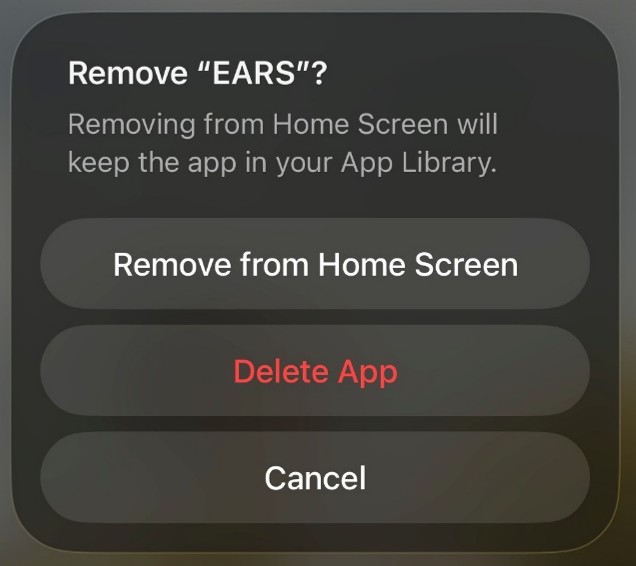
Select ‘Delete App’.
Another pop up will appear. Select ‘Delete’.
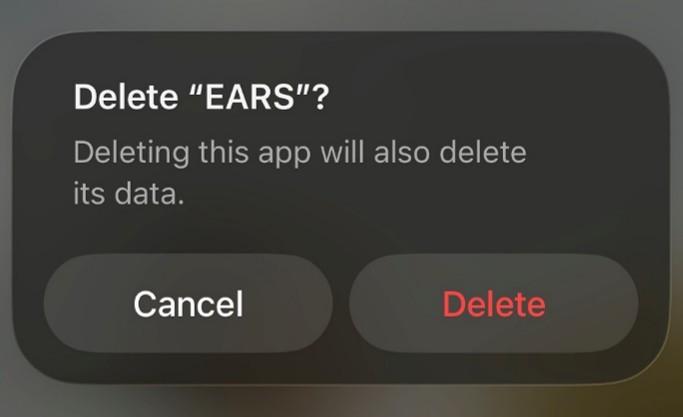
This will delete the app and the related data stored on your phone.
For Android users
Touch and hold the app. A pop up will appear. Select ‘Uninstall’.
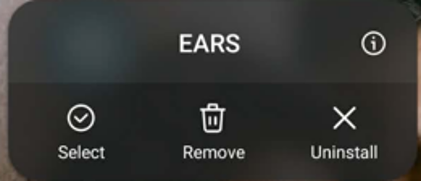
This will delete the app and the related data stored on your phone.